
How Much Should Hosting Cost for an MVP in 2026?
Most MVPs should cost $20 to $100 a month to host. Realistic costs by stage, three example setups with real 2026 prices, and the hidden costs founders miss.

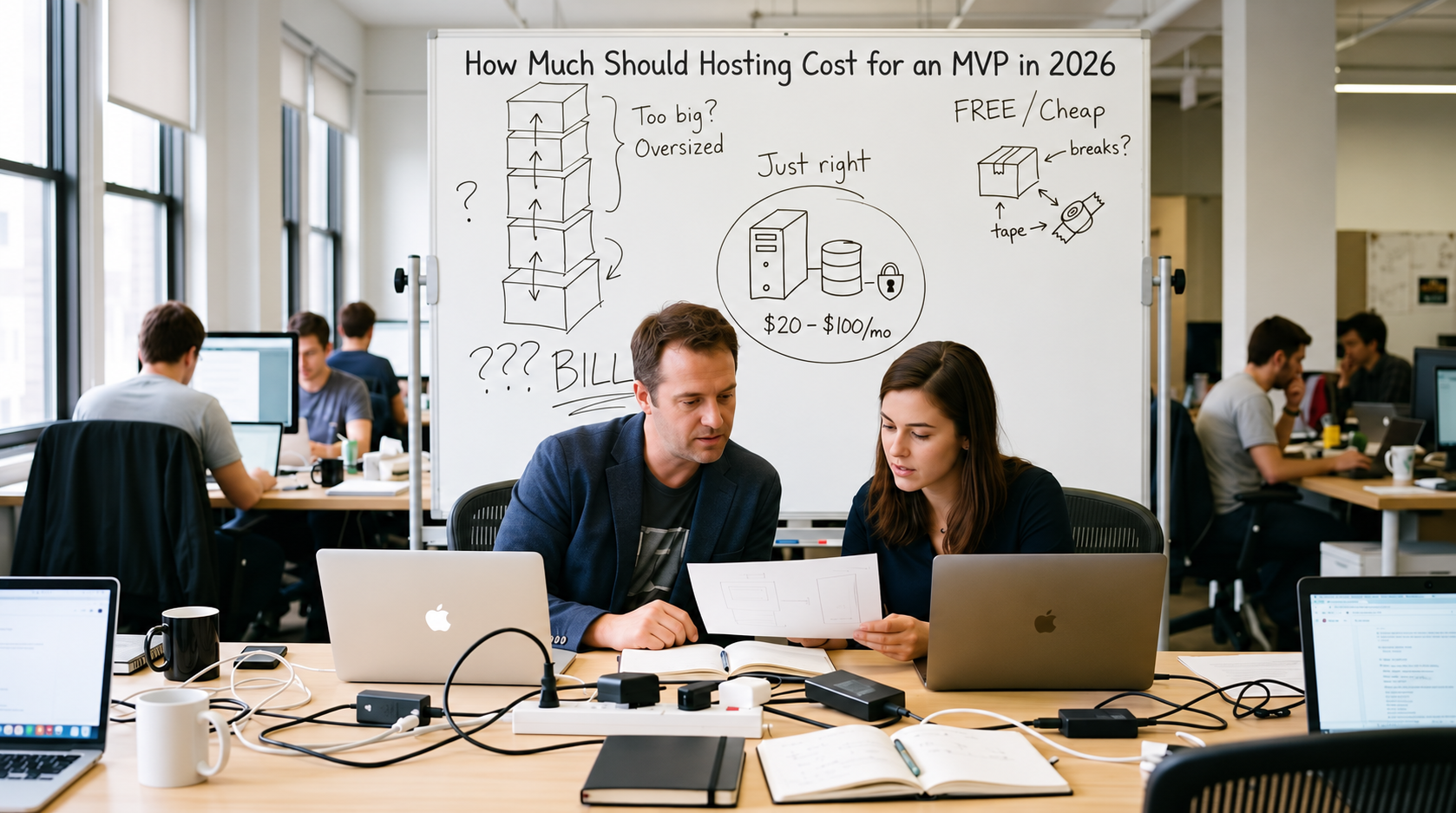
I get asked this on almost every first call with a founder: what should hosting actually cost us?
Founders hear two opposite stories. One says hosting is basically free. The other arrives as a cloud bill that grows a little every month and nobody can quite explain. Neither is what an MVP needs, which is enough to run safely for real users, and nothing more.
Below: realistic costs by stage, three setups with real prices, the hidden costs that catch people out, and how to keep the bill where it should be. All prices are in US dollars, checked in November 2026.
How much does MVP hosting cost in 2026?
It depends on your stage far more than your idea. These are realistic monthly ranges for the hosting bill alone, before team tools and anyone's time:
| Your stage | Typical monthly hosting | What it usually includes |
|---|---|---|
| Prototype, test users only | $0 to $20 | Free tiers or one small server |
| Launched MVP, first paying users | $20 to $100 | App server, database, backups, file storage, basic monitoring |
| Early traction | $100 to $300+ | Second server or load balancer, staging copy, more monitoring |
Two quick sanity checks. Paying customers and a bill under $20 usually means something's missing, normally backups or monitoring. Over $300 before real traction usually means something's bigger than it needs to be.
What are you actually paying for?
A hosting bill is a handful of lines, and at MVP stage only two or three of them really matter:
- Compute: the server or platform that runs your app. Usually the biggest line.
- Database: on the same server, or a separate managed one that handles backups and updates for you.
- Storage and bandwidth: uploaded files, images and the data you send to users.
- Backups and snapshots: copies of your data, ideally kept away from the server.
- Monitoring: uptime checks and error alerts, so a person knows when something breaks.
- The small stuff: domain, email sending, SSL certificates (often free).
When you compare quotes, compare the whole list. A $5 server with no backups isn't cheaper than a $20 setup that includes them. It just moves the cost to the day something breaks.
What do real MVP setups cost? Three examples
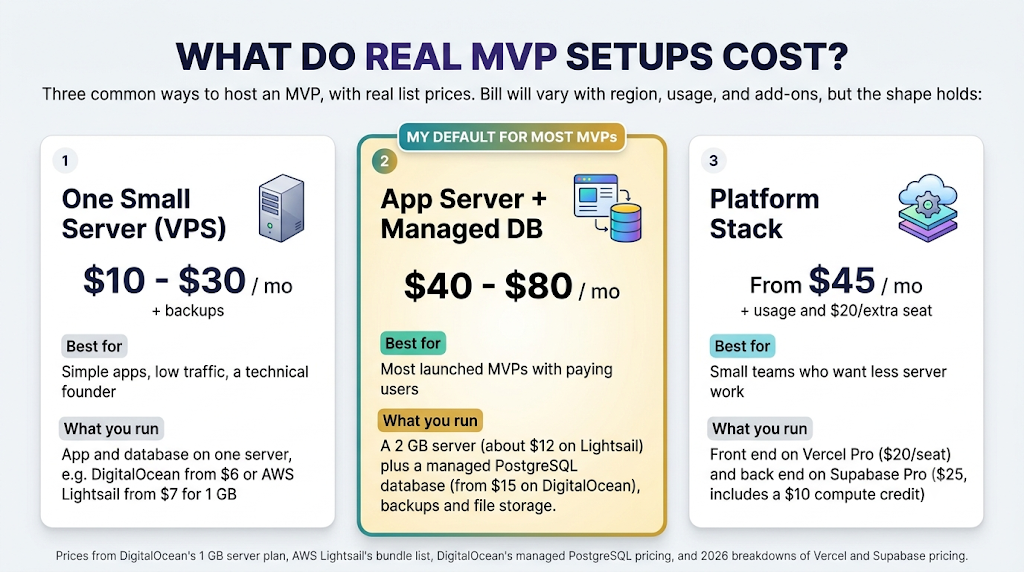
Three common ways to host an MVP, with real list prices. Your bill will vary with region, usage and add-ons, but the shape holds:
| Setup | What you run | Typical monthly cost | Best for |
|---|---|---|---|
| 1. One small server (VPS) | App and database on one server, e.g. DigitalOcean from $6 or AWS Lightsail from $7 for 1 GB | About $10 to $30 with backups | Simple apps, low traffic, a technical founder |
| 2. App server + managed database | A 2 GB server (about $12 on Lightsail) plus managed PostgreSQL (from $15 on DigitalOcean), backups and file storage | About $40 to $80 | Most launched MVPs with paying users |
| 3. Platform stack | Front end on Vercel Pro ($20 per seat) and back end on Supabase Pro ($25, includes a $10 compute credit) | From about $45, plus usage and $20 per extra seat | Small teams who want less server work |
Prices from DigitalOcean's 1 GB server plan, AWS Lightsail's bundle list, DigitalOcean's managed PostgreSQL pricing, and 2026 breakdowns of Vercel and Supabase pricing.
My default for most MVPs with paying users is setup 2. It costs a bit more than one server, but your data's safer and the database isn't fighting your app for memory. The trade-offs are in our post on managed vs self-hosted databases.
Can you host an MVP for free?
A prototype, yes. A product with paying customers, no. Free tiers are great for testing an idea, and the limits are designed to push you onto a paid plan the moment people depend on you:
- Projects pause: Supabase's free projects pause after a week of inactivity.
- No commercial use: Vercel's Hobby plan is for personal projects, not commercial use.
- Tight caps on storage, bandwidth and database size, and usually no backups you control.
- No support. When something breaks at 2am, it's just you.
Validate on free tiers, then move to a paid plan before launch. The jump is usually $20 to $50 a month, which is a lot less than one bad outage.
Is AWS, Google Cloud or Azure the right choice for an MVP?
You can run an MVP on the big clouds, and plenty of people do. But they have hundreds of services and pricing that's easy to get wrong, and I regularly meet founders paying big-cloud prices for a product that would run happily on one or two simple servers.
One startup came to us mid-fundraise with exactly that. Their AWS bill was too big for a product that was still mostly being demoed. The founders had started moving to a simpler server a year earlier and never finished, because the company kept needing them somewhere else. A few small serverless functions had to become ordinary scheduled jobs on the new machine, and we tested everything on the new server before the AWS account was touched. One rule of theirs stuck with me: no code anyone couldn't explain line by line. For a small team that has to live with its setup after we leave, that's the right rule.
Big clouds earn their price when you need what only they offer. Until then, simpler is usually cheaper, and easier for a small team to own.
What are the hidden costs founders miss?
The biggest one is people's time, not servers. Hours spent fixing deployments, chasing outages and tuning servers cost far more than the hosting bill. After that, these are the surprises I see most:
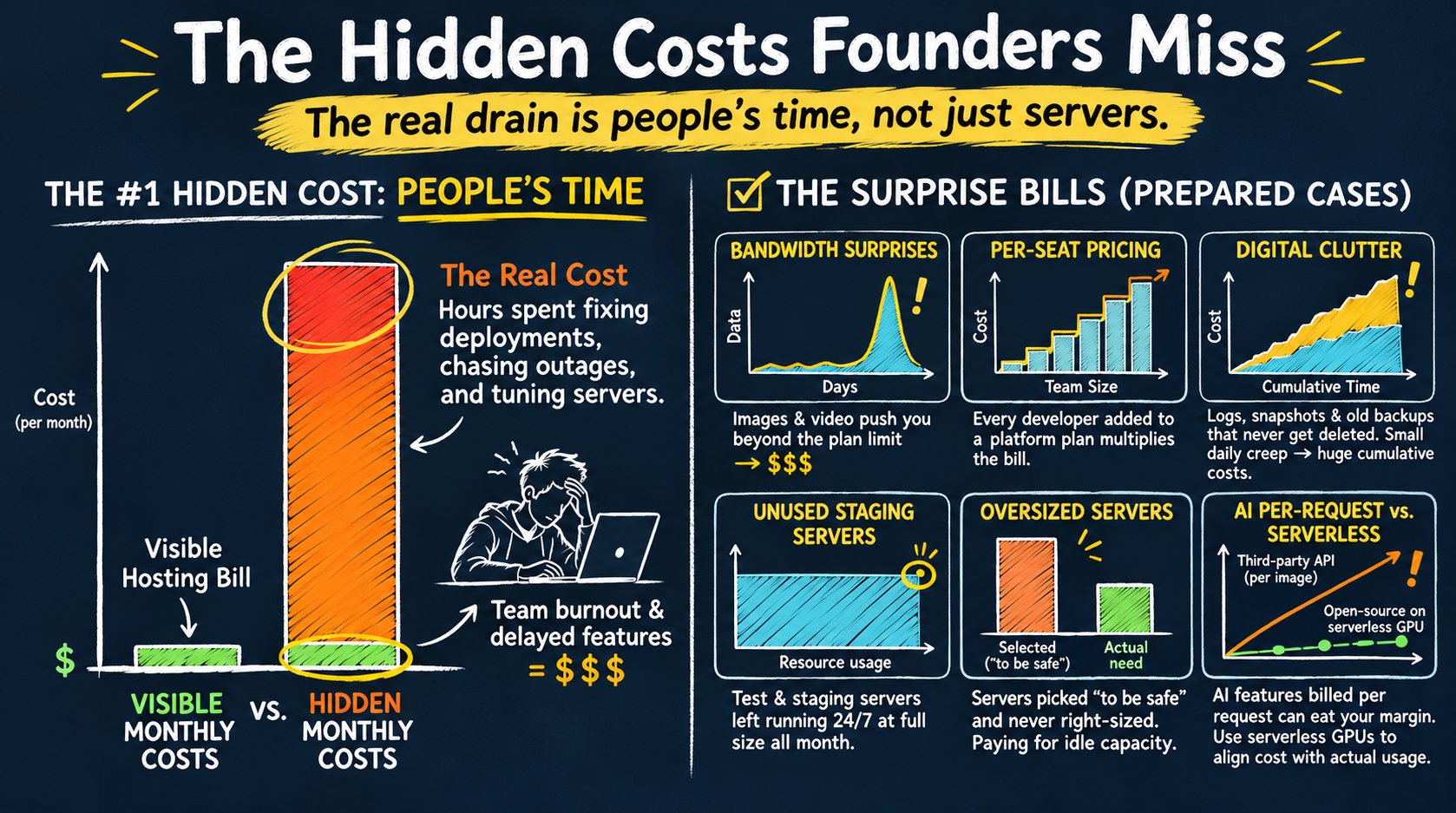
- Bandwidth beyond what the plan includes, especially for images and video.
- Per-seat pricing: every developer you add to a platform plan adds to the bill.
- Logs, snapshots and old backups that pile up and never get deleted.
- Test and staging servers left running all month at full size.
- Oversized servers picked "to be safe" and never right-sized.
- AI features billed per request, which grow with every user before you've earned a cent from them.
That last one is new, and it bites early. A creative-tech startup came to us wanting users to generate comic panels and characters from simple prompts. Paying a third-party AI API per image would have eaten their margin before they had paying users. We ran open-source image models on their own workflows instead, on serverless GPUs that only spin up when someone actually generates something. The bill follows real usage instead of running all day.
And the general waste is real: Flexera's 2026 State of the Cloud report found 29% of cloud spend is wasted, the first rise in about five years (iTWire). At MVP size that's usually a forgotten server or an oversized database.
Not sure if you're overpaying, or missing something important? A senior engineer will review your setup and cloud bill, and send you the findings in writing.
Get a free cloud cost review →Free · Any cloud · No commitment
When should you upgrade your hosting?
When you see a real signal, not "to be safe". Capacity you don't use is the most common waste there is. The signals worth acting on:
- Pages slow down under normal traffic, not just during a spike.
- Servers sit above 70 to 80% busy for long stretches.
- The site goes down during spikes, like a launch or a newsletter (here's why that happens).
- A big customer asks about reliability, backups or security before signing.
Scale in small steps, one change at a time, and measure after each. Most MVPs need a slightly bigger server long before they need a complicated architecture.
How do you keep MVP hosting costs low?
Habits, mostly. Not clever architecture.
- Set a budget and a billing alert, so you hear about a jump in days, not at the end of the month.
- Look at the bill monthly and switch off what nobody uses.
- Right-size to real usage, not "just in case".
- Keep test environments small, or turn them off outside working hours.
- Give the bill one owner, someone accountable for every line on it.
Cost is one of the six jobs in our plain-English guide to DevOps, and it's part of running your app after launch properly.
Is your hosting bill under control? Five quick questions
- Do you know what you paid for hosting last month, to the nearest $10?
- Is there a budget alert on your cloud account?
- Has someone reviewed the bill in the last 30 days?
- Are your servers sized to real usage, not guesses?
- Are backups and monitoring part of what you pay for?
Each "no" is money or risk you're carrying today. Each takes minutes to fix once someone owns it.
Answered "no" to any of these? Go through your bill with a senior engineer.
Book my free production review →30 minutes · Free · The written review is yours to keep
Frequently asked questions
1. How much does it cost to host an MVP?
Most MVPs with real but modest traffic cost between $20 and $100 a month to host in 2026. A simple app on one small server can run for under $20; a setup with a separate managed database, file storage and monitoring usually lands between $40 and $100.
2. Can I host my MVP for free?
You can host a prototype for free, but free tiers are not built for paying customers. They often limit storage, pause inactive projects or forbid commercial use. Once real users depend on the product, budget for a paid plan.
3. Is a VPS or a platform like Vercel cheaper for an MVP?
A single VPS is usually cheaper on paper, from about $5 to $12 a month. Platforms like Vercel and Supabase cost more per month but save setup and maintenance time. The cheaper option is the one your team can run safely.
4. What is the biggest hidden cost of MVP hosting?
Usually people's time, not the servers. Hours spent fixing deployments, chasing outages and tuning servers cost far more than the hosting bill. After that, the common surprises are bandwidth, extra team seats, logs and forgotten test servers.
5. Do I need a managed database for an MVP?
Not always, but it is often worth it. A managed database adds about $15 a month at the low end and takes backups, updates and recovery off your plate. Self-hosting is cheaper but makes all of that your job.
6. How much should I budget for hosting after launch?
Plan for the bill to grow with traffic. Many early products move from under $100 a month to $100 to $300 once they add a second server, a staging copy and monitoring. Review the bill monthly so growth is planned, not a surprise.
7. Why is my cloud bill higher than I expected?
The usual causes are idle or oversized servers, data transfer charges, snapshots and logs that pile up, extra seats on per-user plans and test environments left running. Flexera's 2026 report found 29% of cloud spend is wasted.
8. Should I choose AWS, Google Cloud or Azure for an MVP?
You can, but the big clouds have hundreds of services and complex pricing that is easy to get wrong. For most MVPs, a simpler provider or a small, well-planned setup is cheaper to run and easier to manage until you have a clear need.
9. Does hosting cost include backups and monitoring?
Often not. Backups, snapshots, uptime monitoring and error tracking are frequently extra or limited on cheap plans. Check what is included, and budget for at least daily backups stored away from the server.
10. When should I upgrade my MVP hosting?
Upgrade when you see a real signal: slow pages under normal load, servers regularly above 70 to 80% busy, outages during traffic spikes, or a large customer asking about reliability. Upgrading early just to be safe usually wastes money.
11. How do I stop my hosting costs from growing out of control?
Set a monthly budget and billing alert, review the bill once a month, switch off anything nobody uses, right-size servers to real usage and keep test environments small. Most savings come from these habits, not from switching providers.
12. Is the cheapest hosting plan good enough for production?
Rarely on its own. The cheapest plans often lack enough memory, backups or support for a product with paying customers. A slightly bigger server with backups and monitoring is usually the cheapest safe option.
Conclusion
An MVP doesn't need an expensive setup, and it shouldn't run on hope either. For most products with their first paying users, $20 to $100 a month covers a safe setup: a right-sized server, a database with backups, file storage and basic monitoring.
The real savings come from habits: a budget alert, a monthly look at the bill, and one person who owns it. Get those right and your hosting bill grows with your product, not ahead of it.
Want one team to own your servers, deployments and cloud bill?
Talk to an engineer →One contact for every layer, on your cloud or ours.